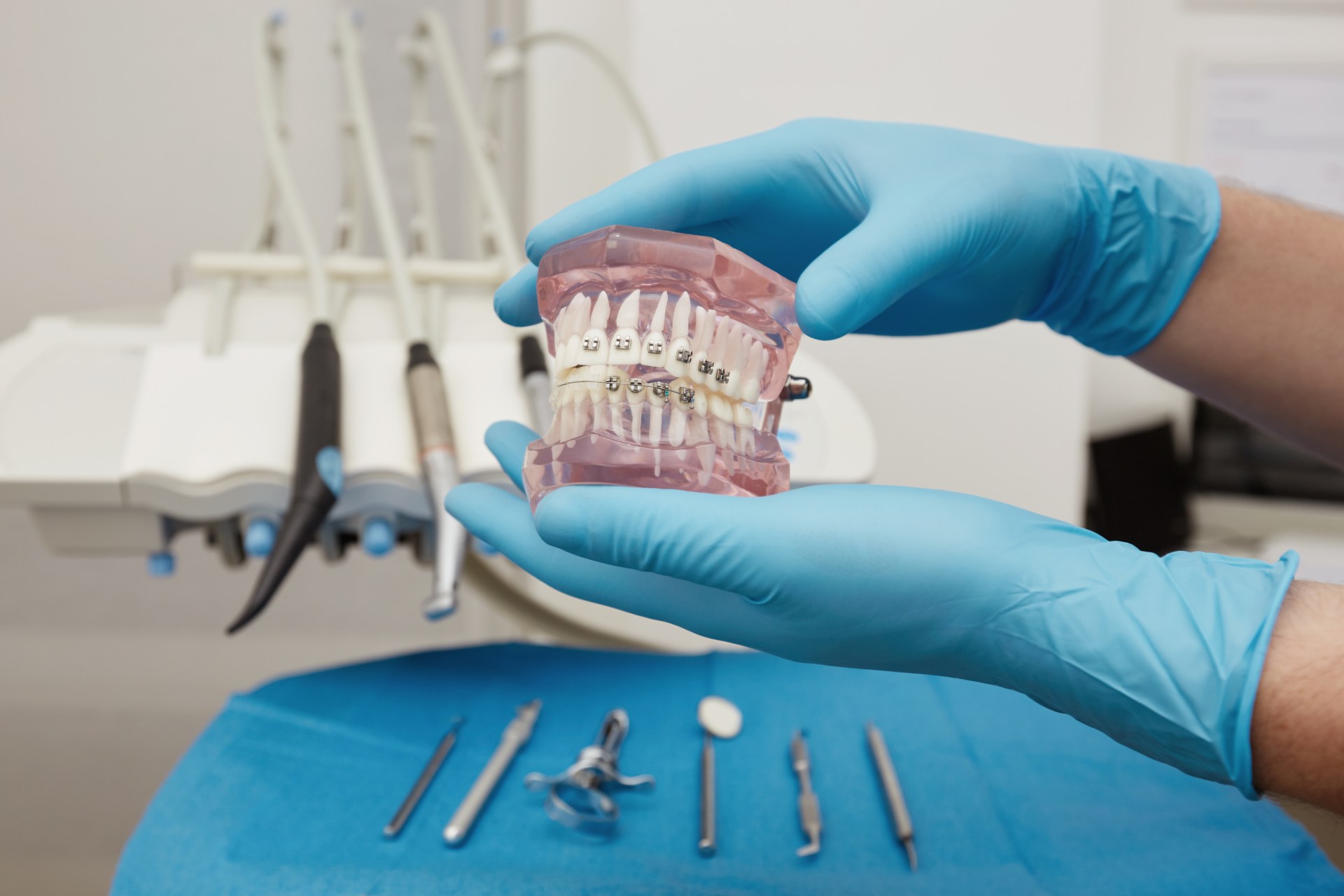
Plan on a retainer for life. Most patients wear one full time for the first few months after treatment, then switch to nights indefinitely. Teeth keep shifting with age whether you finished with braces or clear aligners, and retention is what holds the result.
Why Do Teeth Move Back After Treatment?
Teeth are not set in concrete. Each one sits in bone, suspended by a ligament that stretches and reorganizes while the tooth moves. When the braces come off or the last aligner comes out, that ligament still remembers the old position and the bone around the new one has not finished maturing.
Bone and ligament remodeling
For the first several months after treatment, the fibers around each root are actively remodeling. That is the window when teeth drift fastest and when a missed week of retainer wear shows up as a tooth that suddenly feels tight. Retention during this phase is not maintenance; it is part of the treatment, holding everything still while the supporting structures catch up to the new arrangement.
Age-related crowding
The second reason is permanent. Lower front teeth tend to crowd with age in people who never had orthodontic treatment at all, driven by normal changes in the jaw and the soft tissues. That drift does not stop at twenty-five or forty. A nighttime retainer is the simplest way to outlast it, which is why we frame retention as a lifelong habit rather than a countdown.
How Long Will You Actually Wear Yours?
The honest answer has two parts: an intensive phase measured in months, then a maintenance phase with no end date.
The first few months
Immediately after treatment we usually ask for full-time wear, out only for meals and brushing. This is the least convenient stretch and the most important one. Patients who follow it closely almost always find the nighttime phase easy, because the teeth have stabilized before the wear schedule relaxes.
The nighttime years
After the teeth settle, wear moves to nights. Nights, not most nights: a retainer worn while you sleep costs you nothing in daytime convenience, and it is the reason results from a case you finished as a teenager still look right in your thirties. Keep it by your toothbrush so the habit attaches to something you already do every evening.
Why your schedule may differ
Dr. Alberto Bordonaba and Dr. Zachary DiSpirito set retention case by case. Teeth that were severely rotated, spaces that were closed, an open bite that was corrected or a tongue habit that is still present all justify a longer full-time phase. Patients who finished with braces and those who finished with Invisalign both retain, and the appliance you wore during treatment does not shorten the requirement.
Which Retainer Will You Get?
We choose the retainer to match your case, not by preference. Many patients end up with a combination: a bonded wire behind the lower front teeth and a removable retainer on top.
| Retainer type | How it works | Care notes |
|---|---|---|
| Clear (Essix-style) retainer | A thin transparent shell made from a scan of your finished teeth; nearly invisible | Rinse and brush gently with cool water; never hot water, never the dishwasher; store in its case |
| Hawley-style wire and acrylic retainer | An acrylic body with a front wire that can be adjusted over time; very durable | Brush the acrylic, keep the wire unbent, bring it to every retention check |
| Fixed (bonded lingual) wire | A wire bonded behind the front teeth that holds them without any wear schedule | Floss with a threader or water flosser; call us if you feel a loose spot or a sharp edge |
How Do You Care for a Retainer Without Ruining It?
Almost every replacement we make traces back to one of four things: heat, a napkin, a dog, or a gym bag. All four are avoidable.
Cleaning it properly
Rinse it the moment it comes out, before saliva dries on it, then brush it gently with a soft brush and cool water. Skip toothpaste on clear retainers, since abrasives cloud the plastic. A soak in a retainer cleaning tablet once or twice a week handles the film that brushing misses. Our patient resources page covers the routine we hand out at the end of treatment.
Heat is the enemy
Clear retainers are thermoformed, which means heat undoes them. Hot water, boiling water to sanitize, a dishwasher rack, a car dashboard in August or a windowsill in direct sun will warp a retainer enough that it no longer seats. A warped retainer does not just fit poorly; it can push teeth in directions nobody planned.
Where it goes when it is out
In the case, every time. A retainer wrapped in a napkin on a restaurant table gets thrown away, and one left on a nightstand or a coffee table is exactly at dog height. Keep a second case in your bag so the answer to where do I put this is never the table.
Travel and gym habits
Pack the case in your carry-on rather than the checked bag, and never leave a retainer in a hotel room on a tray. For sports, a retainer is not a mouthguard; take it out, put it in its case, and wear a proper guard. If you commute or travel constantly, tell us and we will talk about a spare set.
What Happens If You Stop Wearing It or Lose It?
Retention slips happen. What matters is how quickly you respond, because the fix scales with the delay.
Small shifts versus real relapse
A few missed nights usually means the retainer feels snug when you put it back in, which is normal. Weeks or months of not wearing it can mean it no longer seats at all. That is the signal that teeth have moved, and forcing an old retainer onto shifted teeth is how retainers crack and how teeth get pushed the wrong way.
Getting a replacement fast
If you lose or break a retainer, call us instead of waiting for your next visit. We can usually scan and make a new one quickly, and a replacement made this week is a far better outcome than one made after three months of drift. Teens who finished treatment are the most common callers, and our teen treatment page explains how we handle retention for that age group.
When a short retreatment is needed
Occasionally teeth move enough that a new retainer alone will not fix it, and a short course of aligners is needed to bring them back before retention resumes. It is a limited plan rather than starting over, and the results we hold long term are the kind you can see in our smile gallery.
How Do You Build the Retainer Habit for Life?
Retention fails for boring reasons: a schedule changed, a case got left at a parent’s house, a college dorm swallowed it. The patients who keep their results for decades are not more disciplined, they just set the habit up so it does not depend on discipline.
Attach it to something you already do
Keep the case next to your toothbrush and put the retainer in right after you brush at night. Anchoring the habit to an existing routine is far more reliable than remembering it on its own, and it also means the retainer gets cleaned when your teeth do rather than sitting in a dry case all day.
Plan for teenagers and college moves
Teens lose retainers at lunch, at practice and on trips, so a spare case in the backpack and one in the sports bag pays for itself. Before a student leaves for college, make sure they know the office number and how to reach us for a replacement, because a lost retainer in September should not become a problem you discover at winter break.
Keep the retention checks
We see patients periodically after treatment to confirm the teeth are holding and the retainer still fits. Those visits are short, and they are where we catch a thinning clear retainer, a bonded wire that has loosened at one tooth, or the early drift that a new retainer can still correct. Bring every retainer you own to each check, including the spare.
Know when to call rather than wait
Call us if a retainer cracks, warps, no longer seats, or has not been worn in more than a couple of weeks, and call if a bonded wire feels sharp or floss suddenly catches. None of those are emergencies, but all of them get cheaper and simpler the sooner we see them.
Retainer FAQs
Can I wear my retainer only a few nights a week?
Some patients stabilize enough over the years that we reduce the schedule, but that is a decision we make at a retention check, not an assumption to make on your own. Until we say otherwise, nightly is the instruction.
How often do retainers need replacing?
Removable retainers wear out with use, and years of nightly wear, cleaning and the occasional drop add up. Bring yours to every checkup so we can see thinning or cracking before it fails.
Do bonded wires last forever?
No. Bonded wires can loosen at one tooth, and a loose bond stops holding while still feeling fine. If you notice a sharp edge, a gap behind a tooth or floss catching, call us.
What if my retainer suddenly feels tight?
Tightness after a few missed nights is usually fine and eases within a night or two. If it will not seat, do not force it; call the office and we will check whether teeth have shifted.
Finishing treatment is the start of retention, not the end of care. If your retainer is lost, broken, warped or has not been worn in a while, Seaport Orthodontics is at 264 Water St. #1M, New York, NY 10038, open Wednesday 8:00am to 4:00pm, Thursday 11:00am to 7:00pm and biweekly Saturdays 9:00am to 2:00pm. Call (917) 830-9638 and we will get you back on track.